Shejrhoi Mirzo Tursunzoda Dust
© 2019
Shejrhoi Mirzo Tursunzoda Dust Average ratng: 9,5/10 3361 reviews
Saadi Shirazi Abū-Muhammad Muslih al-Dīn bin Abdallāh Shīrāzī (: ابومحمد مصلحالدین بن عبدالله شیرازی), better known by his pen-name Saadi ( سعدی Saʿdī( (helpinfo))), also known as Saadi of Shiraz ( سعدی شیرازی Saadi Shirazi), was a major and literary of the medieval period. He is recognized for the quality of his writings and for the depth of his and thoughts. Saadi is widely recognized as one of the greatest poets of the classical literary tradition, earning him the nickname 'Master of Speech' ( استاد سخن) or 'The Master' among scholars. Sniper ghost warrior serial keygen download youtube. He has been quoted in the Western traditions as well. Of his, is one of the 100 greatest books of all time according to. Main interests,,,, Biography Saadi was born in, Iran, according to some, shortly after 1200, according to others sometime between 1213 and 1219. In the Golestan, composed in 1258, he says in lines evidently addressed to himself, 'O you who have lived fifty years and are still asleep'; another piece of evidence is that in one of his qasida poems he writes that he left home for foreign lands when the Mongols came to his homeland Fars, an event which occurred in 1225.
Sohrab Sepehri (Persian: سهراب سپهری ) (October 7, 1928 - April 21, 1980) was a notable modern Persian poet and a painter. He was born in Kashan in Isfahan province. Mirzo Ulugbek was created in 1981.
Llama Pistol Identification. Llama Firearms Website - Firearms identification. Can Llama pistol serial numbers be used to find exact model number? Llama firearms serial numbers for sale. Llama serial # Discussion in '. My serial number on why llama is 79 101 how can I find out what year it was made. Join us to discuss firearms of all kinds, gun. Using Serial Numbers to Determine Date of Manufacture? A document sent to me some time ago, and which I just now noticed, is the same sheet as the above table from the nice people at Ipar Guns. At the bottom of it is, however, another note. In 1995 serial numbers began to follow a coded system. Supposedly, this is. Dates of Production by Model for Llama FIREARMS. Since approximately 1927, Spanish law has required that every firearm manufactured in Spain be submitted to the Eibar Proof House for testing prior to being released for sale. Llama Especial 541xxx, Llama IIIA no stamped serial #,Llama Micromax.32 no stamped serial # The.22 was imported by Stoeger in Hackensack N.J. And the.32 and.380 were imported by RSA Ent Inc in Ocean N.J. Are the engraved numbers on the frame the serial #'s?
It seems that his father died when he was a child. He narrates memories of going out with his father as a child during festivities. After leaving Shiraz he enrolled at the University in, where he studied,,,,, and; it appears that he had a scholarship to study there. In the Golestan, he tells us that he studied under the scholar Abu'l-Faraj ibn al-Jawzi (presumably the younger of two scholars of that name, who died in 1238).
In the Bustan and Golestan Saadi tells many colourful anecdotes of his travels, although some of these, such as his supposed visit to the remote eastern city of in 1213, may be fictional. The unsettled conditions following the invasion of and Iran led him to wander for thirty years abroad through (where he visited the Port of and near met landlords), (where he mentions the famine in ), (where he describes its music,, clerics and elites), and (where he visits the port of and the river). In his writings he mentions the, of, the grand, music and art.
At, Saadi joins a group of who had fought arduous battles against the. Saadi was captured by at where he spent seven years as a slave digging trenches outside its fortress. He was later released after the paid ransom for Muslim prisoners being held in Crusader dungeons. Saadi visited and then set out on a pilgrimage to.
It is believed that he may have also visited and other lands in the south of the. Because of the Mongol invasions he was forced to live in desolate areas and met caravans fearing for their lives on once-lively silk trade routes.
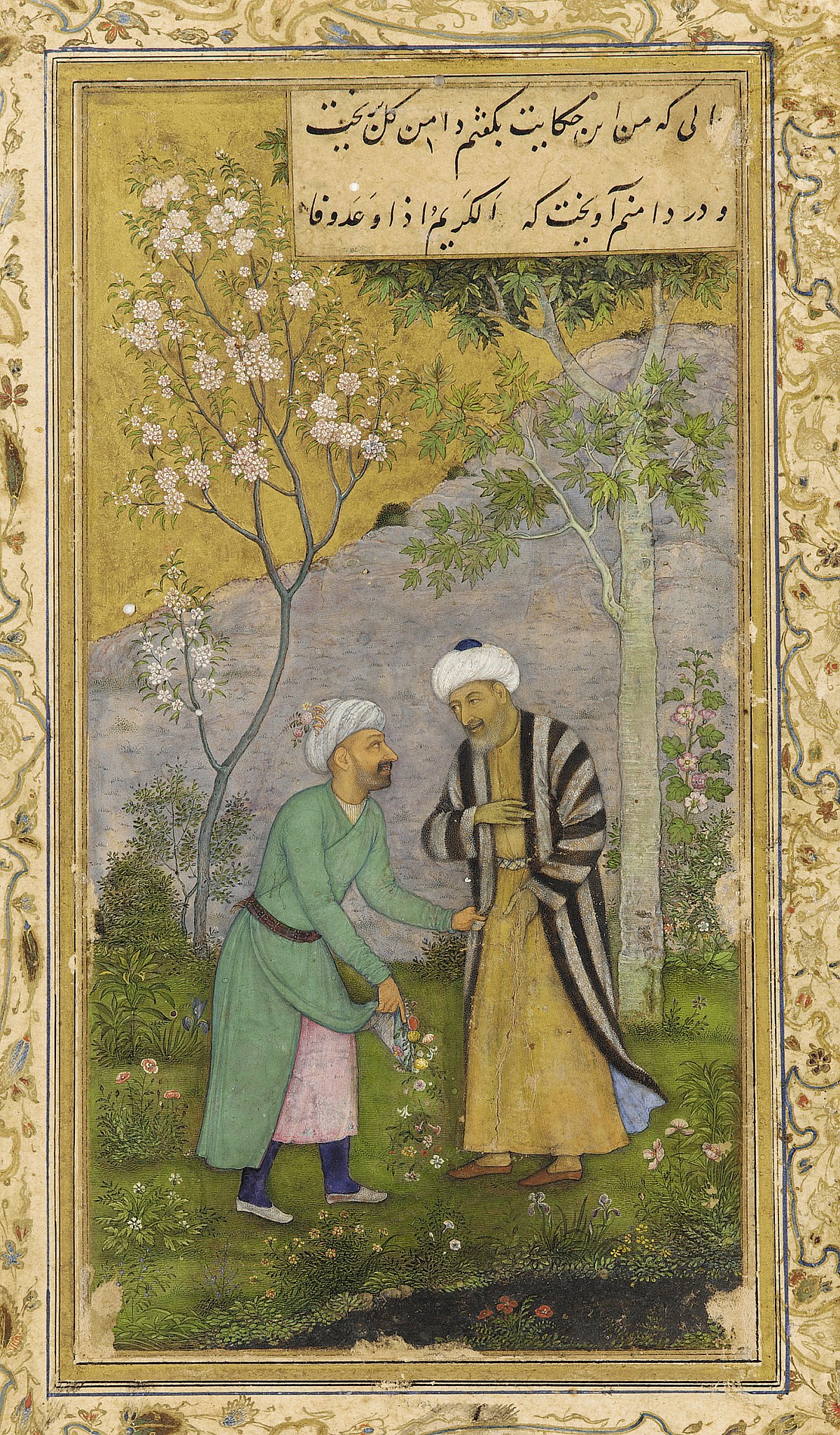
Saadi lived in isolated refugee camps where he met bandits, Imams, men who formerly owned great wealth or commanded armies, intellectuals, and ordinary people. While Mongol and European sources (such as ) gravitated to the potentates and courtly life of rule, Saadi mingled with the ordinary survivors of the war-torn region. He sat in remote tea houses late into the night and exchanged views with merchants, farmers, preachers, wayfarers, thieves, and mendicants. For twenty years or more, he continued the same schedule of preaching, advising, and learning, honing his sermons to reflect the wisdom and foibles of his people. Saadi's works reflect upon the lives of ordinary Iranians suffering displacement, agony and conflict during the turbulent times of the Mongol invasion. Saadi Shirazi is welcomed by a youth from during a forum in.
Saadi mentions honey-gatherers in, fearful of Mongol plunder. He finally returns to Persia where he meets his childhood companions in and other cities. At Saadi befriends a named Tughral.
Saadi joins him and his men on their journey to where he meets Pir Puttur, a follower of the grand master Shaikh Usman Marvandvi (1117–1274). He also refers in his writings about his travels with a Turkic Amir named Tughral in (Pakistan across the and ), India (especially, where he encounters ), and (where he meets the survivors of the Mongol invasion in Khwarezm). Tughral hires sentinels. Tughral later enters service of the wealthy, and Saadi is invited to and later visits the of Gujarat. During his stay in, Saadi learns more about the and visits the large temple of, from which he flees due to an unpleasant encounter with the. Katouzian calls this story 'almost certainly fictitious'.